
Navigating the world of public relations requires a strategic understanding of communication, media relations, and crisis management. A degree in public relations provides the foundational knowledge and practical skills necessary to thrive in this dynamic field. This guide explores the diverse aspects of public relations degree programs, from curriculum specifics to career prospects and the evolving role of PR in the digital age.
We will delve into specializations, accreditation, and the essential skills needed to build a successful career.
Understanding the various pathways within public relations is crucial for aspiring professionals. This guide will not only detail the typical curriculum and career paths, but also illuminate the unique challenges and rewards of specific specializations, offering a nuanced perspective on building a fulfilling career in this dynamic field. The increasing importance of digital media and ethical considerations will also be addressed, ensuring a comprehensive overview of the modern public relations landscape.
Overview of Public Relations Degree Programs
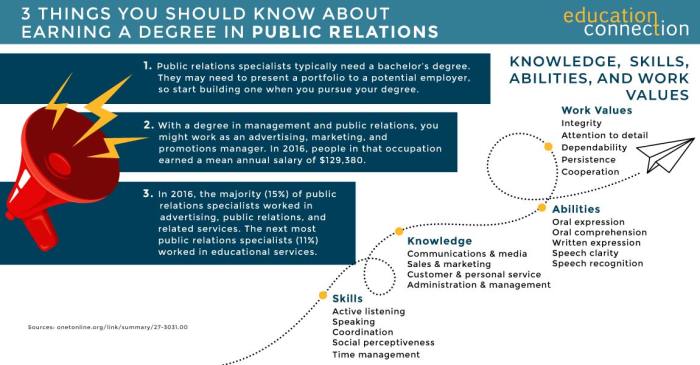
Public relations (PR) degree programs equip students with the theoretical knowledge and practical skills necessary to manage and shape public perception of individuals, organizations, and brands. These programs cover a broad range of topics, preparing graduates for diverse and dynamic careers in the communications field. A successful PR professional needs strong communication skills, strategic thinking, and an understanding of media relations.
Typical Curriculum of a Public Relations Degree Program
A typical public relations curriculum blends theoretical coursework with hands-on practical application. Core courses often include public relations writing and media relations, crisis communication, strategic communication planning, social media marketing, research methods, and public opinion. Students also frequently take courses in related fields like marketing, advertising, journalism, and communications law. Many programs incorporate internships or practicums, allowing students to gain real-world experience and build their professional networks.
Electives might focus on specialized areas like healthcare PR, political communication, or international PR.
Comparison of Undergraduate and Graduate Public Relations Programs
Undergraduate PR programs provide a foundational understanding of the field, introducing students to core concepts and skills. These programs typically lead to a Bachelor of Arts (BA) or Bachelor of Science (BS) degree. Graduate programs, such as Master of Arts (MA) or Master of Science (MS) degrees, delve deeper into specialized areas and provide advanced theoretical knowledge and practical skills.
Graduate programs often cater to students who already have a bachelor’s degree in a related field or those seeking to specialize in a particular area of PR. Undergraduate programs are generally more focused on foundational knowledge, while graduate programs offer greater specialization and advanced study.
Career Paths for Public Relations Graduates
Graduates with a public relations degree can pursue a wide array of career paths. Common roles include public relations specialist, media relations manager, social media manager, communications manager, crisis communications specialist, and marketing communications specialist. These roles can be found across various industries, including non-profit organizations, government agencies, corporations, and entertainment companies. Some graduates may choose to start their own PR firms or work as freelance consultants.
Career progression often involves increasing responsibility and management roles, leading to senior positions like director of communications or vice president of public relations.
Essential Skills Gained Through a Public Relations Degree Program
A public relations degree cultivates a diverse skillset crucial for success in the field. The following table highlights some key skills:
| Communication Skills | Strategic Thinking & Planning | Media Relations | Digital & Social Media Skills |
|---|---|---|---|
| Writing (press releases, speeches, etc.) | Developing communication strategies | Building and maintaining media relationships | Managing social media platforms |
| Public speaking and presentation skills | Project management | Pitching stories to journalists | Utilizing social listening tools |
| Interpersonal communication and relationship building | Crisis communication planning | Media monitoring and analysis | Creating engaging content |
| Active listening and persuasive communication | Budget management | Understanding media ethics and legal considerations | Analyzing social media data and metrics |
Specializations within Public Relations Degree Programs
Public relations is a multifaceted field, offering a range of specializations to cater to diverse interests and career aspirations. Choosing a specialization allows students to focus their studies and gain expertise in a specific area of the industry, enhancing their job prospects and earning potential upon graduation. This section will explore three distinct specializations within public relations, comparing their respective focuses, career paths, and salary expectations.
Public Relations Specializations: Crisis Communication
Crisis communication management is a critical specialization within public relations, focusing on protecting an organization’s reputation during times of emergency or negative publicity. Professionals in this area are responsible for developing and implementing communication strategies to mitigate damage, manage stakeholder expectations, and restore public trust. This requires a deep understanding of media relations, risk assessment, and strategic communication planning.
The coursework typically includes crisis simulation exercises, media training, and ethical considerations in crisis management. Practical experience often involves working with simulated crises or assisting in real-world crisis response efforts within an organization. Job prospects are generally strong, particularly for experienced professionals, with salaries often exceeding the average public relations salary due to the specialized skills and high-pressure nature of the work.
A senior crisis communications manager in a large corporation might earn a six-figure salary.
Public Relations Specializations: Digital and Social Media Public Relations
With the increasing importance of digital platforms, this specialization is highly sought after. It focuses on leveraging digital channels, such as social media, websites, and email marketing, to build brand awareness, engage audiences, and manage online reputation. Professionals in this field need to be adept at content creation, social media strategy, optimization, and data analytics. The curriculum typically includes courses on social media marketing, digital content strategy, and web analytics.
Practical experience might involve managing social media accounts for organizations, developing digital marketing campaigns, or conducting social media audits. Job prospects are excellent, given the ever-growing demand for digital marketing expertise. Salary expectations are competitive, often aligning with or exceeding the average for general public relations roles, particularly for those with demonstrable success in driving engagement and achieving measurable results.
A successful social media manager for a large brand could easily earn a salary in the range of $70,000-$100,000 annually.
Public Relations Specializations: Healthcare Public Relations
This specialization focuses on the unique communication challenges within the healthcare industry. It involves promoting health initiatives, managing hospital reputations, building relationships with healthcare professionals, and communicating complex medical information to the public. The curriculum would include courses in healthcare marketing, medical terminology, and health communication ethics. Practical experience might involve working in a hospital’s public relations department, assisting with health campaigns, or creating educational materials for patients.
Job prospects are consistently strong due to the ongoing need for effective communication in the healthcare sector. Salary expectations vary depending on experience and employer, but generally, this specialization offers competitive compensation. A seasoned healthcare PR professional could command a salary well above the average for general public relations positions.
Career Progression in Digital and Social Media Public Relations
The following flowchart illustrates a potential career path within Digital and Social Media Public Relations:[Imagine a flowchart here. The flowchart would start with “Entry-Level Social Media Specialist” branching into “Social Media Manager” and “Digital Content Creator.” The “Social Media Manager” branch could then lead to “Senior Social Media Manager” and “Director of Social Media.” The “Digital Content Creator” branch could lead to “Content Marketing Manager” and “Head of Content.” All these positions would show increasing salary expectations and responsibility.] The flowchart visually depicts the progression from an entry-level position to increasingly senior roles with enhanced responsibilities and higher earning potential.
Each step involves acquiring new skills, taking on more leadership responsibilities, and demonstrating a proven track record of success. This progression illustrates the growth opportunities available within this dynamic specialization.
Accreditation and Rankings of Public Relations Programs
Choosing a public relations program requires careful consideration. The quality and reputation of the program significantly impact your career prospects. Understanding accreditation and program rankings can help you make an informed decision. Accreditation signifies a program’s adherence to established educational standards, while rankings offer a comparative overview of program performance based on various factors.
Accreditation in public relations education assures prospective students that a program meets specific quality benchmarks. It signifies that the curriculum, faculty, and resources meet a rigorous standard set by independent accrediting bodies. This accreditation process ensures a consistent level of excellence across programs, making it easier for employers to identify graduates who possess the necessary skills and knowledge. Accreditation also often enhances a program’s credibility and increases the likelihood of graduates securing internships and employment opportunities.
Reputable Accrediting Bodies for Public Relations Education
Several organizations provide accreditation for public relations programs. These bodies evaluate programs based on factors such as curriculum, faculty qualifications, resources, and student outcomes. Choosing a program with accreditation from a recognized body is a strong indicator of quality.
While a comprehensive list is beyond the scope of this section, some well-respected accrediting bodies for public relations education include the Accreditation Council for Education in Journalism and Mass Communications (ACEJMC) in the United States. Other regional or national accrediting bodies may exist in other countries, and prospective students should research the accrediting bodies relevant to their geographical location and educational aspirations.
It’s crucial to verify the accreditation status directly with the institution and the accrediting body itself.
Criteria Used to Rank Public Relations Programs
Public relations program rankings are often compiled using a variety of criteria. These criteria can include faculty expertise and research output, student-to-faculty ratio, career placement rates, starting salaries of graduates, reputation among employers, and the program’s overall reputation within the field. Different ranking organizations may prioritize different criteria, leading to variations in rankings. It is essential to review the methodology used by any ranking organization to understand the basis for their assessment.
Top 5 Public Relations Programs (Illustrative Example)
The following list represents a hypothetical ranking of top public relations programs. Actual rankings vary across different publications and organizations, and the relative positions of these programs may change from year to year. This example uses reputation and student outcomes as key factors. Note that this is not an exhaustive list, and many other excellent programs exist.
- University of Southern California (USC) Annenberg – Known for its strong industry connections and highly regarded faculty.
- University of Texas at Austin – Renowned for its comprehensive curriculum and research opportunities.
- Syracuse University S.I. Newhouse School of Public Communications – Highly respected for its focus on strategic communication and media studies.
- Columbia University Graduate School of Journalism – Offers a strong reputation for its rigorous academic program and emphasis on journalistic ethics and practices.
- University of North Carolina at Chapel Hill – Established program with a long history of producing successful public relations professionals.
The Role of Public Relations in Modern Society
Public relations (PR) has undergone a dramatic transformation in the digital age, evolving from a primarily media-focused discipline to a multifaceted strategic communication function encompassing various channels and platforms. Its role in modern society is now more critical than ever, impacting public perception, shaping policy, and influencing societal trends. This evolution demands a high degree of ethical awareness and adaptability from PR professionals.Public relations professionals navigate a complex landscape, constantly adapting to the evolving media landscape and technological advancements.
The instantaneous nature of digital communication requires swift and strategic responses, demanding a 24/7 operational mindset. The ability to leverage data analytics to inform campaigns and measure their effectiveness is paramount.
The Evolving Role of Public Relations in the Digital Age
The digital age has fundamentally reshaped the public relations landscape. Traditional media relations, while still relevant, are now complemented by a multitude of digital channels, including social media, blogs, websites, and email marketing. PR professionals must now be proficient in digital storytelling, content creation, search engine optimization (), and social media management. The emphasis has shifted from one-way communication to a more interactive and engaging dialogue with stakeholders.
For instance, a company launching a new product might use social media listening tools to understand consumer sentiment before, during, and after the launch, allowing for real-time adjustments to their communication strategy. This shift requires a deep understanding of audience segmentation and the ability to tailor messages for different platforms and demographics.
Ethical Considerations Facing Public Relations Professionals
Ethical conduct is the cornerstone of successful and sustainable public relations. The instantaneous nature of digital communication amplifies the potential for miscommunication and reputational damage. Maintaining transparency, accuracy, and fairness in all communications is crucial. Ethical dilemmas arise frequently, particularly concerning issues such as truthfulness in advertising, the use of influencers, and the protection of client confidentiality.
For example, a PR professional might face a conflict of interest if they are asked to promote a product that they personally believe is harmful. Navigating these complexities requires a strong ethical compass and adherence to professional codes of conduct, such as those established by organizations like the Public Relations Society of America (PRSA).
The Impact of Social Media on Public Relations Strategies
Social media has become an indispensable tool for public relations professionals. Platforms like Twitter, Facebook, Instagram, and LinkedIn provide direct access to target audiences, facilitating two-way communication and real-time feedback. Social listening allows PR professionals to monitor brand mentions, identify emerging trends, and address concerns proactively. However, the immediacy and virality of social media also present challenges, as negative comments or crises can spread rapidly.
A well-crafted social media strategy should include a robust crisis communication plan and a proactive approach to community management. For example, a company facing a product recall might utilize social media to communicate with affected customers directly, offering solutions and minimizing reputational damage. Successful strategies often involve engaging authentically with audiences, building relationships, and creating shareable content.
The Importance of Crisis Communication in Public Relations
Crisis communication is a critical aspect of public relations, involving the strategic management of negative events or situations that threaten an organization’s reputation. A well-prepared crisis communication plan is essential for mitigating damage and restoring public trust. This plan should include pre-identified spokespeople, established communication channels, and a clear message strategy. The speed and accuracy of information dissemination are paramount during a crisis.
Effective crisis communication involves transparency, empathy, and a commitment to taking responsibility for mistakes. For example, a company experiencing a data breach should communicate openly with customers, outlining the steps taken to address the issue and prevent future incidents. Failing to respond effectively can result in significant reputational damage and financial losses.
Exploring PUBLIC RELATIONS as a Career Field
Public relations (PR) is a dynamic and rewarding career path for those with strong communication skills, a keen understanding of human psychology, and a passion for shaping public perception. It’s a field that constantly evolves, adapting to new technologies and societal shifts, offering diverse opportunities and challenges.
Key Responsibilities of a Public Relations Professional
PR professionals wear many hats. Their core responsibilities revolve around managing and protecting an organization’s reputation. This involves crafting and disseminating strategic messages to target audiences, building and maintaining relationships with media outlets, handling crises effectively, and monitoring public sentiment. Specific tasks can range from writing press releases and organizing events to developing social media campaigns and managing online reputation.
They are often responsible for measuring the effectiveness of their efforts and adapting strategies as needed.
Work Environments for Public Relations Specialists
Public relations specialists find employment across a vast spectrum of industries and organizations. They can work in-house for corporations, non-profits, government agencies, or educational institutions. Alternatively, they may choose to work for public relations agencies, where they manage multiple clients across diverse sectors. Some PR professionals may specialize in specific areas, such as healthcare, technology, or politics, further diversifying their work environments.
Freelance opportunities also exist, allowing for flexibility and a varied client base. For example, a PR specialist working for a tech startup will focus on different strategies than one working for a non-profit organization focused on environmental conservation.
Required Soft Skills and Personality Traits for Success in Public Relations
Success in public relations requires a unique blend of hard and soft skills. While technical skills like writing and media relations are crucial, strong interpersonal skills are equally vital. Excellent communication, both written and verbal, is paramount. Problem-solving skills are essential for navigating crises and crafting effective strategies. Creativity and strategic thinking are needed to develop innovative campaigns.
Adaptability and resilience are also key, as the PR landscape is constantly changing. Finally, a proactive, detail-oriented, and organized personality helps manage multiple projects simultaneously and meet tight deadlines. The ability to remain calm under pressure and work effectively under tight deadlines is particularly crucial.
A Typical Day in the Life of a Public Relations Professional
A typical day for a PR professional is rarely typical. It might begin with reviewing media coverage, responding to emails, and monitoring social media for mentions of their clients or organization. This could be followed by drafting a press release for an upcoming product launch, brainstorming ideas for a new social media campaign, or preparing for a client meeting.
The afternoon might involve pitching stories to journalists, attending a networking event, or analyzing campaign performance data. The day could conclude with preparing a presentation for an upcoming board meeting or crafting a crisis communication plan. The constant influx of information and the need for quick responses are hallmarks of the profession. This unpredictable nature, however, is often what makes the career so engaging and rewarding.
Building a Successful Public Relations Portfolio
A compelling public relations portfolio is crucial for securing your dream job. It serves as a tangible demonstration of your skills and experience, allowing potential employers to assess your capabilities beyond your resume. A well-crafted portfolio showcases not just your theoretical knowledge but your practical application of PR principles in real-world scenarios.A strong public relations portfolio comprises a variety of components that collectively illustrate your expertise.
It’s more than just a collection of documents; it’s a carefully curated presentation of your best work, strategically chosen to highlight your most relevant skills and achievements. The portfolio should be easily navigable and visually appealing, reflecting professionalism and attention to detail.
Portfolio Components
The ideal portfolio includes a diverse range of projects that showcase different aspects of your PR skillset. This could encompass media relations, crisis communication, social media management, event planning, or content creation. The key is to demonstrate versatility and a capacity to handle diverse PR challenges. For example, one project might involve a successful social media campaign that boosted brand awareness, while another might highlight your skills in drafting compelling press releases that resulted in significant media coverage.
Always prioritize projects that yielded measurable results, quantifying your impact whenever possible.
Examples of Suitable Projects
Including a variety of projects demonstrates breadth of skills. A successful campaign to launch a new product, complete with a detailed case study outlining strategy, execution, and results, is highly valuable. Similarly, a crisis communication plan developed for a hypothetical scenario, along with a presentation showing how you would manage it, showcases your preparedness and strategic thinking. A portfolio might also include samples of your writing, such as press releases, blog posts, or speeches, demonstrating your ability to craft compelling narratives.
Finally, contributions to student publications or volunteer work in PR roles offer valuable experience to showcase.
Showcasing Writing Samples, Media Kits, and Campaign Results
Writing samples are fundamental. Include well-written press releases that secured media coverage, compelling blog posts that engaged target audiences, or impactful speeches that effectively communicated a message. These demonstrate your ability to craft clear, concise, and persuasive communication. Media kits showcasing your understanding of media outreach and brand storytelling are equally important. They should include press releases, fact sheets, and high-quality images.
Quantifiable results from your campaigns are essential. Use metrics such as media impressions, website traffic, social media engagement, or sales figures to demonstrate the impact of your work. Always connect your accomplishments to specific goals and objectives.
Tips for Effectively Presenting a Public Relations Portfolio
Before presenting your portfolio, consider these points for optimal impact.
- Tailor your portfolio: Customize the content to align with the specific requirements and expectations of each potential employer. Highlight projects and skills most relevant to the job description.
- Use a professional platform: Present your portfolio using a professional online platform, such as a website or a well-designed PDF document. Ensure easy navigation and a visually appealing design.
- Keep it concise: Avoid overwhelming potential employers with excessive information. Focus on showcasing your best and most relevant work.
- Quantify your achievements: Use data and metrics to demonstrate the impact of your work whenever possible. For example, quantify increased brand awareness, media coverage, or sales generated through your efforts.
- Practice your presentation: Rehearse your presentation to ensure a confident and articulate delivery. Be prepared to discuss your projects in detail and answer questions effectively.
- Seek feedback: Before submitting your portfolio, seek feedback from professors, mentors, or peers to identify areas for improvement.
Ultimately, a public relations degree equips individuals with the communication prowess, strategic thinking, and ethical awareness necessary to navigate the complexities of modern public relations. Whether focusing on traditional media or leveraging the power of digital platforms, graduates are well-positioned for rewarding careers in a variety of sectors. By understanding the diverse specializations, accreditation standards, and the evolving role of PR, aspiring professionals can confidently chart their course toward a successful and impactful career.
Quick FAQs
What is the average salary for a public relations graduate?
Salaries vary greatly depending on experience, specialization, location, and employer. Entry-level positions typically offer a range, while experienced professionals can earn significantly more.
Are internships crucial for public relations students?
Yes, internships provide invaluable real-world experience, build your network, and strengthen your resume, significantly improving job prospects.
What types of writing skills are essential for public relations?
Strong writing skills are paramount, encompassing press releases, speeches, website content, social media posts, and more. Clarity, conciseness, and adaptability to different audiences are key.
How important is networking in public relations?
Networking is crucial. Building relationships with professionals in the field opens doors to internships, jobs, and mentorship opportunities.


